
30 years of Myrtha Pools in Australia
In 1996, Myrtha Pools installed its first pool in Australia. Thirty years later, that first project has grown into a nationwide presence, contributing to the country’s aquatic landscape, from community learn-to-swim facilities to world-class competition venues.
“Community pools are a much loved and integral part of our way of life. They are places where kids learn to swim, families stay active and neighbours catch up. Royal Life Saving is grateful that Myrtha has been right there for 30 years, helping keep these facilities modern, safe and open for communities, right across the country.”
Justin Scarr, CEO of Royal Life Saving Australia.
This milestone reflects more than longevity. It marks three decades of collaboration with Australia’s aquatic sector, built on performance, innovation and a consistent focus on long-term value.
“When we built that first pool in Perth in 1996, we were introducing Australia to a technology that was then almost unknown on this continent. Thirty years later, Myrtha pools sit at the heart of some of the most celebrated aquatic facilities in the Southern Hemisphere. We are enormously proud of what has been built, not just in stainless steel and water, but in trust, performance, and partnership with the Australian aquatic community.”
Roberto Colletto, CEO of Myrtha Pools.
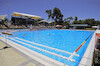
Myrtha’s Australian journey began at Challenge Stadium in Perth, today the Perth High Performance Centre in Mount Claremont, ahead of the 8th FINA World Championships in 1998. The brief was clear: deliver an outdoor water polo pool to expand the venue’s capabilities.
The solution was anything but conventional. Myrtha introduced its stainless-steel modular system, at the time virtually unknown in Australia, delivering a 33-metre in-ground pool with a full-perimeter overflow gutter. What followed became a defining moment. While adjacent concrete tiled pools required significant remediation within less than a decade, the Myrtha pool continued to perform with minimal maintenance. The difference was not theoretical. It was operational, visible and measurable. That performance built trust. In 2007, the venue again turned to Myrtha to renovate two existing 50-metre outdoor pools using RenovAction technology, ahead of the FINA World Masters Championships. It was an early demonstration of a principle that continues to guide Myrtha’s work in Australia: durability and lifecycle value over short-term construction cost.
A decade after its Australian debut, Myrtha was selected to contribute to one of the country’s most important aquatic venues: the Melbourne Sports and Aquatic Centre, known as MSAC. For the 2006 Commonwealth Games, Myrtha delivered a 50-metre outdoor competition pool designed to meet international competition standards. With a movable bulkhead and movable floor, the pool provides the flexibility required for different aquatic disciplines while maintaining the precision needed for elite sport. The facility remains a benchmark today, continuing to support high-level events as well as daily community use. It shows how investment linked to a major event can become lasting public infrastructure when designed with a long-term view.
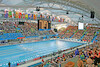
In 2011, Myrtha delivered a full multi-pool installation at the South Australia Aquatic and Leisure Centre in Adelaide, now widely regarded as one of the fastest swimming venues in the world. The centre was designed as a high-performance hub, with Myrtha contributing to multiple pools, including the Olympic competition pool and a deep-water facility for diving and water polo. Movable bulkheads allow for different configurations, while underwater windows support coaching, analysis and broadcast needs. SAALC represented a new stage in Myrtha’s presence in Australia: not only introducing technology, but helping create facilities where elite sport, training and community use can coexist. While major venues have given Myrtha visibility, its impact in Australia extends well beyond flagship projects.
Today, more than 200 Myrtha pools are in operation across the country. Many of them are community facilities, supporting learn-to-swim programmes, recreation and rehabilitation: essential infrastructure in a nation where water safety is a fundamental life skill. Partnerships with organisations such as Royal Life Saving Australia, together with contributions to regional and remote community projects, reflect a broader commitment to improving access to aquatic facilities, supporting safety outcomes and helping communities stay active. This approach aligns closely with the Australian understanding of pools: not only as sports infrastructure, but as important civic and community assets.
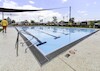
“Reaching 30 years in Australia is not just a milestone, it is a responsibility. It reflects the trust we have earned across the industry and the communities we serve. Our role today is to continue supporting Australia with solutions that are sustainable, high-performing, and designed for the long term. We are not just delivering pools; we are contributing to the social and civic fabric of this country.”
Chiara Cenati, Country Manager, Myrtha Pools Australia
Recent projects continue to show how aquatic facilities are evolving. The Parramatta Aquatic Centre, awarded at the 2024 World Architecture Festival and recognised with the 2025 IOC-IAKS Architecture Prize, reflects a broader shift in the way pools are designed, bringing together technical performance, sustainability, architectural quality and community value.
These recognitions reinforce a long-standing belief: successful aquatic facilities are not only built for performance. They are also designed to serve people, communities and public life over time. Thirty years on, Myrtha’s presence in Australia is defined not by a single project, but by a sustained contribution to aquatic infrastructure across the country. From a pioneering installation in Perth to a network of facilities supporting elite athletes and local communities, the journey reflects a clear philosophy: to deliver aquatic solutions built on innovation, reliability and long-term partnership.
Last photo credits: M&J Builders & Blueprint Aquatics


